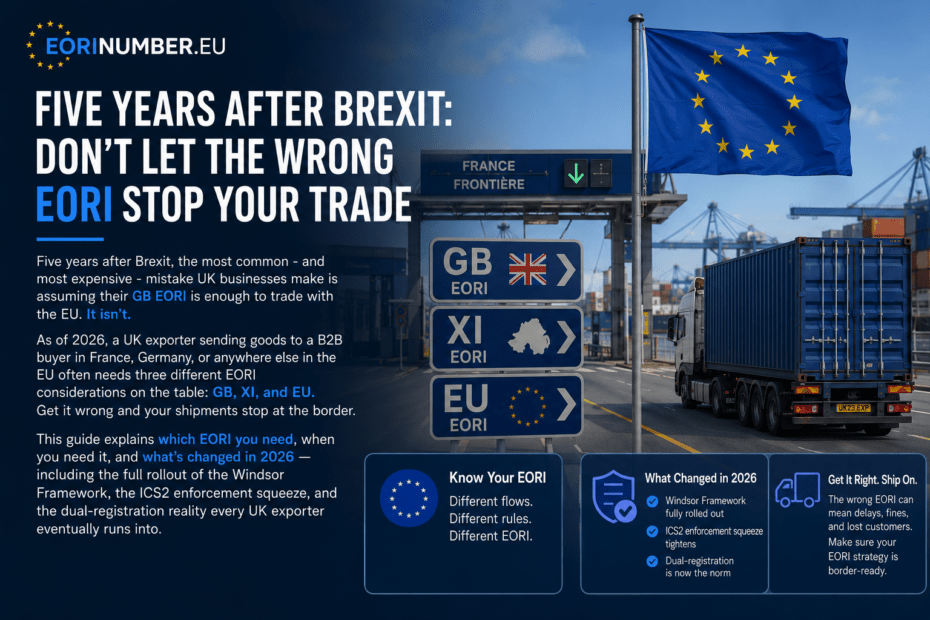
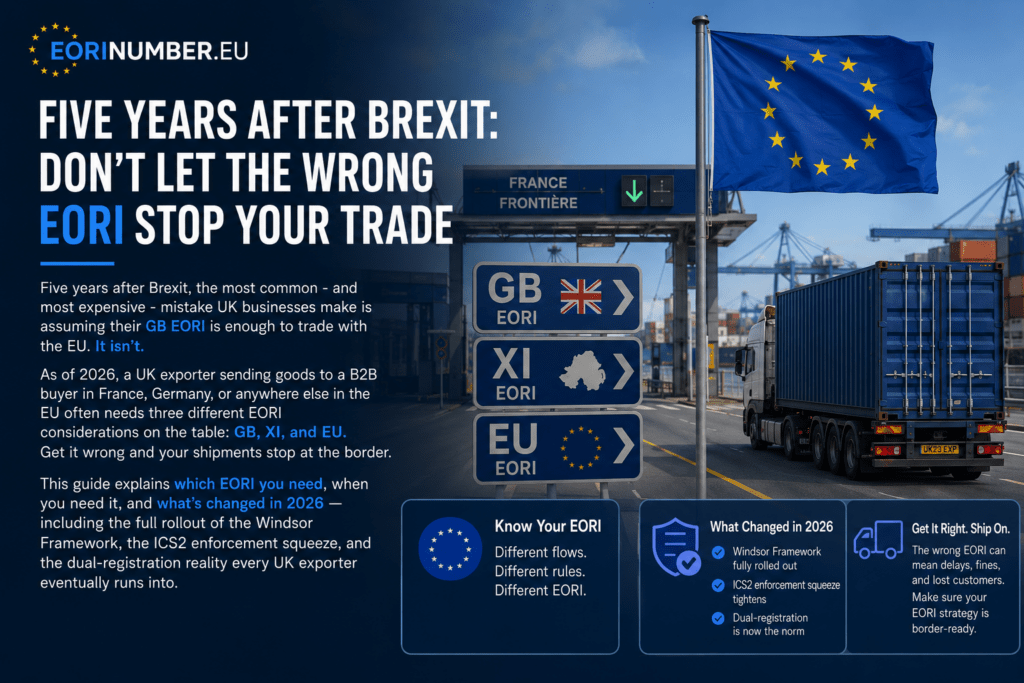
Five years after Brexit, the most common – and most expensive – mistake UK businesses make is assuming their GB EORI is enough to trade with the EU. It isn’t. As of 2026, a UK exporter sending goods to a B2B buyer in France, Germany, or anywhere else in the EU often needs three different EORI considerations on the table: GB, XI, and EU. Get it wrong and your shipments stop at the border.
This guide explains which EORI you need, when you need it, and what’s changed in 2026 — including the full rollout of the Windsor Framework, the ICS2 enforcement squeeze, and the dual-registration reality every UK exporter eventually runs into.
The Three EORIs UK Businesses Need to Understand
Before Brexit, “EORI” meant one thing. After Brexit, it splintered into three distinct registrations covering three distinct jurisdictions. Mixing them up is the single biggest source of held shipments at UK-EU borders today.
| EORI type | Prefix | Issued by | Valid for |
|---|---|---|---|
| GB EORI | GB | HMRC | UK customs declarations only (England, Scotland, Wales) |
| XI EORI | XI | HMRC | Northern Ireland movements under the Windsor Framework |
| EU EORI | FR, DE, IE, EE, NL, etc. | Customs authority of an EU Member State | All customs activity inside the EU |
Each one is a separate registration with separate paperwork. Holding all three is normal for businesses with cross-border supply chains. The catch: HMRC issues two of them (GB and XI), but the third — your EU EORI — must be obtained from an EU Member State directly. HMRC cannot help with that one.
When Your GB EORI Is Not Enough
A GB EORI lets you submit UK customs declarations through CDS (the Customs Declaration Service, which fully replaced CHIEF in December 2024). It does not let you act as importer or exporter on the EU side of the border. The moment your name appears on an EU customs declaration, an EU EORI is required.
Common scenarios where UK businesses discover they need an EU EORI:
- Selling DDP (Delivered Duty Paid) to EU customers. You’re acting as importer of record in the EU. EU EORI required.
- Holding stock in an EU fulfilment centre. Amazon FBA EU, Shopify Markets Pro, or any 3PL with EU warehousing — your goods enter the EU under your name. EU EORI required.
- Dropshipping into the EU. Even if you never touch the goods, if you’re the consignee or declarant, EU EORI required.
- Returns processing in the EU. Re-imports under your name trigger the same rule.
- Selling to EU B2B buyers who refuse to act as importer. More common than you’d think — many EU buyers now insist on DDP terms.
- Exhibiting at EU trade shows. Temporary imports still require declaration.
If any of these describes your business, a GB EORI alone is leaving you exposed.
The Windsor Framework and the XI EORI
The Windsor Framework, fully implemented in May 2025, replaced the Northern Ireland Protocol with a green-lane/red-lane system for goods moving between Great Britain and Northern Ireland. The framework has direct EORI consequences for any business touching NI.
- Green lane goods (not at risk of entering the EU single market) — moved with simplified paperwork, but still require XI EORI registration to use the UK Internal Market Scheme.
- Red lane goods (at risk of entering the EU) — treated as full EU imports, requiring complete EU customs declarations and an XI EORI on the NI side.
- Businesses established only in Great Britain moving goods to NI can hold both a GB and an XI EORI simultaneously.
- Businesses established in Northern Ireland trading directly with the EU are treated as EU-established for customs purposes — and use their XI EORI for EU declarations.
⚠ The Windsor Framework does not eliminate the need for an EU EORI when you’re acting on the EU mainland. XI EORI is specifically for movements through the NI route. A UK business shipping directly to a customer in Spain or Italy still needs an EU EORI issued by a Member State.
Why 2026 Is the Year This Got Worse for UK Exporters
Two regulatory changes converged at the start of 2026 to push the GB-EORI-is-enough myth into the open:
1. ICS2 Release 3 enforcement
The EU’s Import Control System 2 (ICS2) became fully operational across all transport modes in September 2025, and most national derogations expired on 31 December 2025. Every commercial shipment entering or transiting the EU now requires an Entry Summary Declaration (ENS) — and the EU consignee’s EORI is a mandatory data field. UK exporters who relied on lax enforcement during the transitional period are seeing carrier-level rejections in 2026.
2. The TCA Article 776 review
The UK-EU Trade and Cooperation Agreement was reviewed under Article 776 in 2026. The review confirmed the core structure — zero tariffs, zero quotas, subject to rules of origin — but added targeted administrative simplifications. None of those simplifications removes the EORI requirement. If anything, the cleaner declaration process makes the gap of a missing EU EORI more visible to customs systems.
Net effect: the freight forwarders who used to quietly absorb missing-EORI friction are out of slack. Bookings get rejected at origin, and the bill lands on the UK exporter.
How to Get an EU EORI as a UK Company
An EU EORI is issued by the customs authority of one EU Member State and is then valid across all 27. The choice of Member State matters more than most UK exporters realise, because it affects:
- Language of submission. Ireland, the Netherlands, and Estonia accept English. France, Germany, Italy, and Spain expect local-language documents.
- Fiscal representation requirements. Some Member States require a UK company to appoint a local fiscal representative; others don’t.
- Processing speed. Times range from 24 hours (with the right local knowledge) to 4–6 weeks (DIY through a national portal in your second language).
- Documentation standards. Each Member State asks for certificate of incorporation, proof of address, and ID of the legal representative — but the acceptable formats and certifications vary.
For most UK businesses without an existing EU presence, Ireland or Estonia are the practical default — both accept English documentation and have efficient processing.
| Route | Realistic timeline | Best for |
|---|---|---|
| DIY through a national customs portal | 2–6 weeks | UK companies with an EU office and local-language capacity |
| Through your EU customs broker | 1–3 weeks | UK businesses already using a customs agent for declarations |
| Specialist EORI registration agent | 24–72 hours | UK exporters who need an EU EORI before their next shipment |
What It Costs to Get It Wrong
The concrete costs of shipping without the right EORI in 2026:
- Carrier rejection at origin. Increasingly common — your booking is refused before the goods even leave your warehouse.
- Held at the EU border. Goods sit in customs storage until a valid EORI is provided. Demurrage runs at hundreds of euros per day for sea freight.
- Failed delivery to B2B customers. Your buyer cancels, refuses to pay, or charges back. Relationship damage outlasts the delay.
- VAT and duty exposure. Some Member States apply punitive treatment to shipments where the declarant cannot be identified at the time of import.
- Repeated flagging. EU customs IT systems track patterns. Repeated EORI errors trigger enhanced screening on future shipments.
The pattern: one held container can cost more in a week than ten years of EORI compliance.
Frequently Asked Questions
I have a GB EORI from before Brexit. Is it still valid?
Yes. Pre-Brexit UK EORI numbers were automatically converted to GB-prefixed format and remain valid for UK customs. HMRC has updated some validation checks since, so it’s worth confirming your registered details are current. The GB EORI is not, however, valid for EU customs.
Can a UK business hold both a GB EORI and an EU EORI?
Yes — and in many post-Brexit scenarios, you need both. The two systems operate independently. UK customs use the GB EORI; EU customs use the EU EORI issued by a Member State.
Do I need an XI EORI if I don’t trade with Northern Ireland?
No. The XI EORI is specifically for movements involving Northern Ireland under the Windsor Framework. If your supply chain doesn’t touch NI, you don’t need one.
My EU customer says they’ll handle the import — do I still need an EU EORI?
If your customer acts as importer of record (typically DAP or DDU/DAP terms), they handle EU clearance under their own EU EORI. You only need an EU EORI if you act as importer or declarant in the EU — most commonly under DDP terms or when stocking goods in an EU warehouse.
Does the Trade and Cooperation Agreement (TCA) remove the EORI requirement?
No. The TCA delivers zero-tariff, zero-quota trade for qualifying goods, but it does not change customs identification requirements. Both sides still need to identify the declarant — that’s what EORIs are for. The 2026 Article 776 review confirmed this.
How long does an EU EORI take to obtain for a UK company?
Anywhere from 24 hours to 6 weeks, depending on the Member State and how the application is prepared. The bottleneck is usually documentation formatting, not processing time. A specialist registration agent typically returns a valid EU EORI in 24–72 hours.
Which EU Member State should a UK company register in?
Ireland and Estonia are common defaults for UK businesses without a physical EU presence — both process English-language applications quickly. The Netherlands is another solid option. If you have an existing EU office, supplier base, or fulfilment centre, registering in that country can simplify downstream paperwork.
Does my EU EORI work across all 27 Member States?
Yes. An EU EORI is issued by one Member State but is valid for customs activity across the entire EU. You only need one EU EORI, regardless of how many Member States you ship into.
Get Your EU EORI quickly
If you’re a UK business shipping to the EU — whether through Amazon FBA, direct B2B sales, DDP terms, or any other route where your name appears on the EU side of the declaration — you need an EU EORI. The longer you delay, the more likely your next shipment hits the post-2025 ICS2 enforcement wall.
We register EU EORI numbers for UK businesses with a flat fee, no hidden costs, and the fastest turnaround on the market.
- Standard registration: €149 flat — typical turnaround 3 business days
- Priority registration: €249 — priority handling with customs side fast-track
- No subscriptions, no upsells, no surprises
- Applications prepared and submitted by people who do this every day
Not sure whether you need an EU EORI, or unsure which Member State to register in? Send us your details and we’ll check the EU database and recommend the fastest route for your business.
EORI Number is a private registration agent that helps businesses prepare and submit EORI applications to EU customs authorities. We are not affiliated with the European Commission, HMRC, or any national customs authority. EORI numbers are issued by HMRC (for GB and XI EORIs) and by EU Member State customs authorities (for EU EORIs).