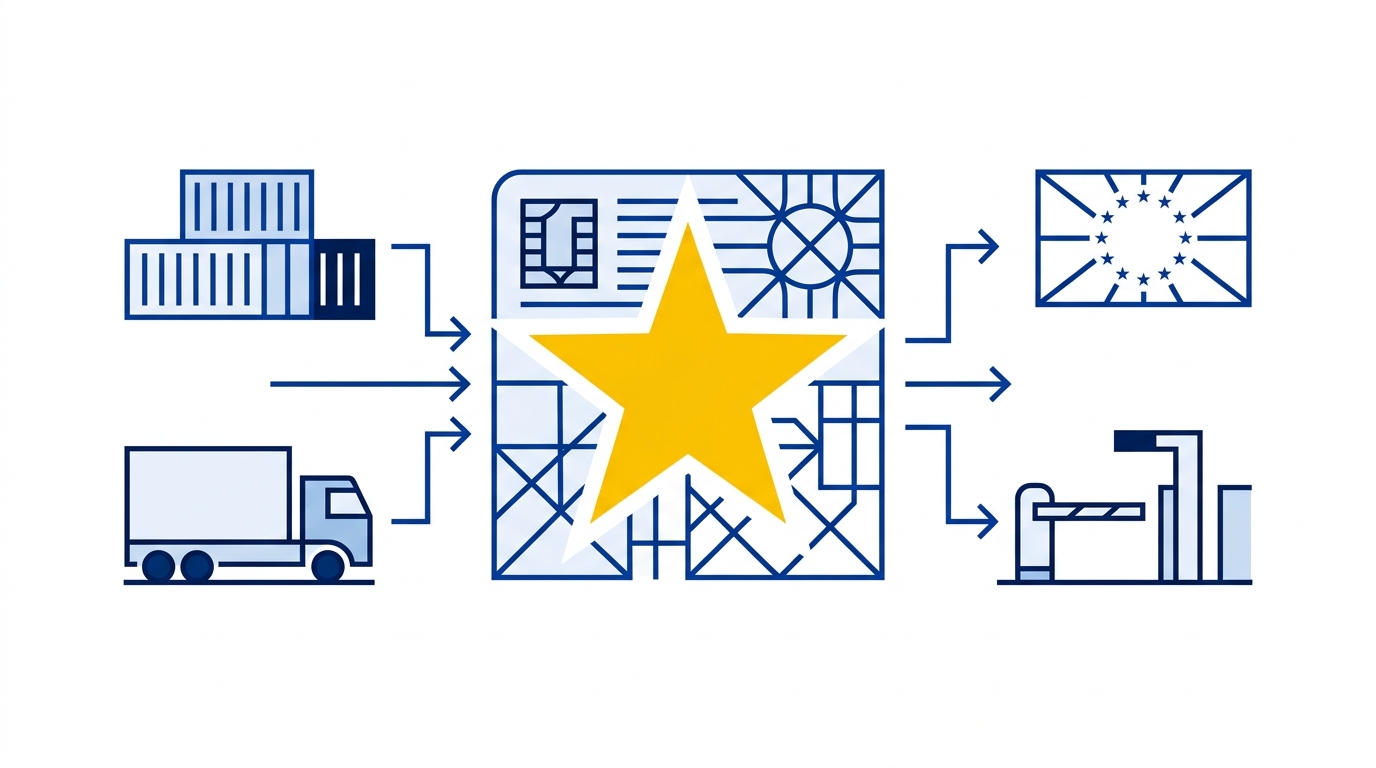
An EORI number is the identification number customs authorities use to recognise your business every time your goods cross an EU border. If your company imports or exports commercially, you need one – and without it, your consignment does not clear customs.
That is the short version. The longer version is where the confusion starts: which country you register in, why a British number stops working at the EU border, and why your VAT number is not a substitute. This guide answers those in the order they actually come up.
In short: An EORI number is the identification number customs authorities use to recognise your business every time goods cross an EU border. If you import or export commercially, you need one. It is issued free by the authority, never expires, and a number issued in any one member state is valid across all 27.
What an EORI number actually is
EORI stands for Economic Operators Registration and Identification. The legal definition, from Article 1(18) of the Union Customs Code Delegated Regulation, is an identification number “unique in the customs territory of the European Union, assigned by a customs authority to an economic operator or to another person in order to register that person for customs purposes.”
Stripped of the legal phrasing: one number, one business, one customs identity across all 27 member states. You register once, in one country, and the number is recognised in every other. The customs system in Rotterdam and the customs system in Lisbon read the same identifier and see the same company.
Two things follow from that, and both save people money:
- It is a registration, not a licence. Nobody assesses whether your business is fit to trade. You are being entered into a database so that declarations can be attributed to you.
- It is free from the authority. Customs authorities do not charge for issuing an EORI number. Anything you pay goes to whoever does the paperwork for you – never to the state.
What an EORI number looks like
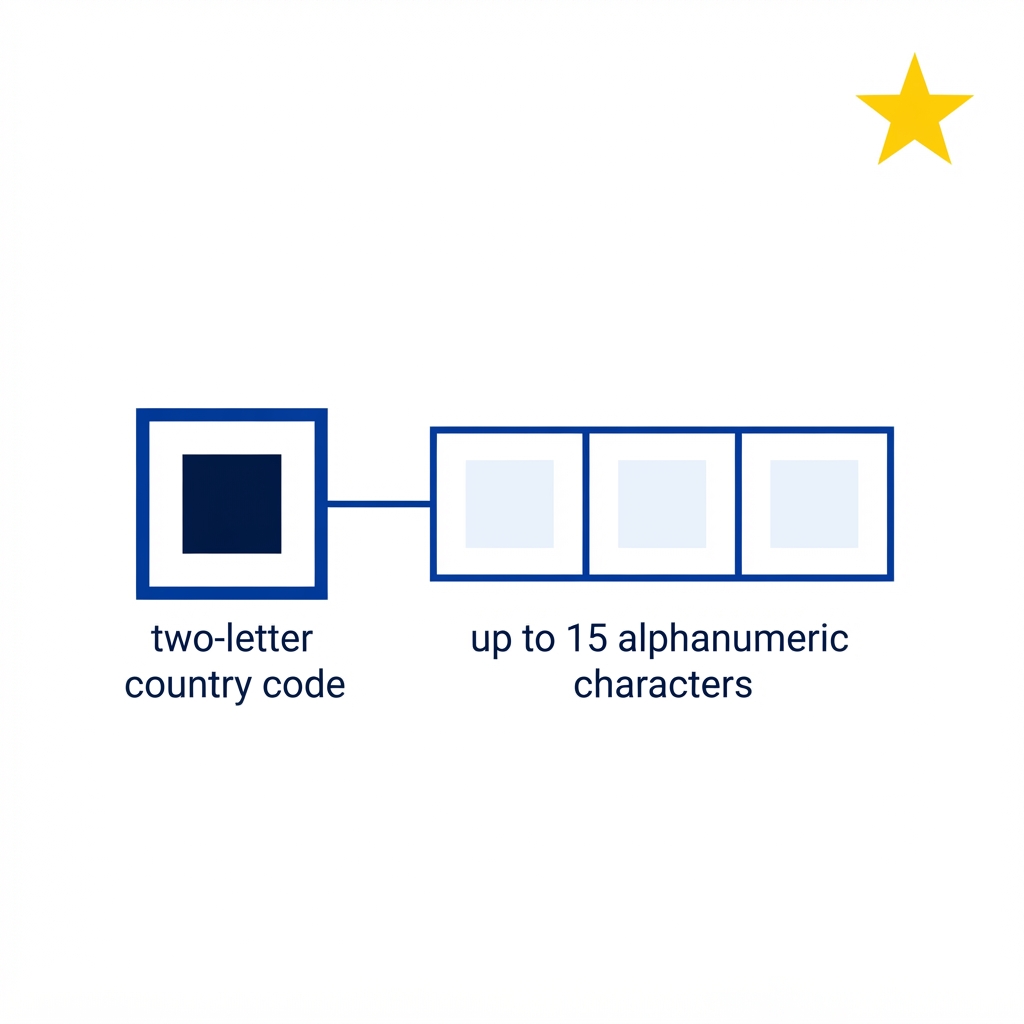
Every EORI number has two parts. First, the two-letter ISO country code of the member state that issued it. Second, up to 15 alphanumeric characters that are unique within that country. A Dutch number opens with NL, a German one with DE, and a Polish number might read PL1234567890ABCDE.
Many member states simply reuse a number your business already has – a VAT number or a company registration number – as the second part. That is why an EORI number often looks oddly familiar the first time you see it, and why people assume it is “just the VAT number with letters in front.” It usually isn’t, and the exceptions are country-specific. The country-by-country patterns are set out in our EORI number format reference.
Skip the paperwork – we file EORI applications in any EU member state for a flat €148. See how it works →
Who needs an EORI number, and who doesn’t
If your business is established in the EU
If your business is established in the customs territory of the Union and you lodge customs declarations, registration is mandatory. That is Article 9(1) of the Union Customs Code, and it applies whether you import, export, or move goods under transit or storage procedures.
Size is irrelevant. A sole trader shipping one pallet a year is registered on exactly the same basis as a distributor shipping a container a week. There is no turnover threshold and no small-business exemption.
If your business is established outside the EU
You are not registered automatically, but you are required to register as soon as you perform any of the activities listed in Article 5 of the Delegated Regulation. In practice, you need an EU EORI number if you:
- lodge a customs declaration in the EU – import, export or transit
- lodge an entry summary, exit summary or temporary storage declaration
- act as a carrier for transport by sea, inland waterway or air
- apply for proof of the customs status of Union goods
That covers most non-EU companies importing into the EU under their own name. If you are a US business shipping to European customers or into an EU warehouse, assume you need one, and read our page on EORI numbers for US companies for the sequence.
When you probably don’t need one
- You are a private individual receiving personal goods. Member states may waive registration for natural persons who lodge only occasional declarations.
- You do not sell into or out of the EU at all.
- Your goods never leave one member state. Domestic movement is not a customs matter.
- Somebody else is the importer of record. If a marketplace, carrier or fulfilment partner clears the goods in their own name, the number on the declaration is theirs. Check rather than assume – most do not offer this, and the ones that do usually charge for it. Sellers on Amazon’s European marketplaces should read EORI for Amazon FBA before deciding.
An EORI number is not permission to import. A company established outside the EU generally also needs an indirect customs representative – a party established in the EU that lodges the declaration in its own name and is jointly liable for the customs debt. An EORI number does not replace that, and no agent can register you out of it.
Where you register: the rule that trips people up
If your business is established in the EU
You register in the member state where your business is established. Not where your customers are, not where your goods land. A German company registers in Germany even if everything it imports arrives in Antwerp.
If your business is established outside the EU
The rule here is narrower than most people expect, and getting it wrong costs weeks. The European Commission’s own EORI guidance is explicit: economic operators not established in the customs territory of the Union “must be registered by the customs authority of the Member State where they first expect to perform one of the activities listed” – that is, the country where you will first lodge a declaration or apply for a customs decision.
Not the country where your largest customer sits. Not the country with the lowest corporate tax rate. Not the country whose language you happen to read. In practice it is almost always the country of first entry: goods landing at Rotterdam point to the Netherlands, goods landing at Lisbon point to Portugal, goods trucked in through Hamburg point to Germany.
Once issued, the number works everywhere. Registering in the Netherlands does not tie you to Dutch ports for the rest of your trading life – it is a registration, not a lease. You choose the country of first customs activity, and after that the number travels with you.
If you are weighing up options, which EU country to register your EORI in works through the decision with the practical differences between member states.
GB, XI and EU numbers are not interchangeable
Since 2021 there are three families of number a British-linked business may hold:
| Prefix | Issued by | Used for |
|---|---|---|
GB… | HMRC | Moving goods to and from Great Britain |
XI… | HMRC | Movements involving Northern Ireland |
NL…, DE…, FR… etc. | An EU member state | Customs formalities inside the EU |
The mistake we see most often is a UK company with a perfectly valid GB EORI assuming it covers imports into the EU. It does not. A GB number is not recognised by EU customs systems. If your company is named as importer or exporter on an EU declaration, you need an EU number, issued by an EU member state, in addition to the GB one you already hold.
The reverse also holds: an EU EORI does nothing for you at the GB border. The two systems separated at the end of the transition period and have not converged since. The differences are set out in full on our GB EORI vs EU EORI page, and UK businesses trading into the EU should start with EU EORI numbers for UK companies.
HMRC issues GB EORI numbers free of charge, usually within a few working days, and you apply directly with HMRC. We do not register GB EORI numbers. If you already have one and can’t find it, we can locate it for €148 – and if you trade with the EU, you’ll need a separate EU EORI, which we do register.
What an EORI number is not
Four things get mistaken for an EORI number often enough to be worth naming.
Not a VAT number
Different register, different purpose, different authority in many countries. VAT registration is about tax; EORI registration is about identifying you on a customs declaration. Holding one does not give you the other, and needing one does not always mean needing the other. The overlap is real enough to deserve its own explanation – see EORI vs VAT number.
Not a customs representative
An EORI number identifies you. It does not lodge declarations for you, and it does not make anyone liable on your behalf. Non-EU importers still need a direct or indirect representative to file.
Not an import licence or product approval
CE marking, food safety controls, dual-use export licences, sanctions screening – all separate, all still required, none of them covered by having an EORI number.
Not per shipment, per country or time-limited
One number covers every shipment and every member state. It does not expire, it does not renew annually, and you do not need a second one because you started shipping to a different country. You would only need a further registration if you set up a separately established legal entity, which gets its own.
How to get an EORI number
There are three honest routes, and the cheapest one is not always the cheapest one.
| Route | What it costs | What it takes | Best when |
|---|---|---|---|
| Apply yourself, direct | Free | The member state’s portal, the documents below, and the local language | You have time and read the language |
| Ask your forwarder or broker | Often included | A phone call, and their capacity to do it | You already have a customs partner |
| Use a registration agent | €148 flat | 3 minutes of form filling | You want it filed correctly the first time |
What you need, whichever route you take
- Legal company name and registered address, exactly as they appear in your national register
- Company registration number
- VAT number, where you have one
- A named contact and email address
- A short description of the goods, and sometimes the expected date of first shipment
- Proof of establishment or a certificate of incorporation – occasionally apostilled or translated
- A power of attorney, if somebody files on your behalf
The requirements vary by member state more than you would expect, and the variation is where most rejections come from. The country-by-country detail lives in documents you need for EORI registration.
How long it takes
Some member states issue automatically within hours. Others review manually and take several working days, longer if a document needs certifying or translating. Our own applications are typically completed in 1–5 business days. The realistic ranges by country are in how long an EORI number takes.
Check before you apply
A surprising number of businesses already have an EORI number and do not know it – assigned years ago by a forwarder, or created automatically alongside a VAT registration. Before you apply for anything, run the number you suspect you have through the European Commission’s validation service, or use our EORI number check. Applying twice creates a duplicate record that then has to be unwound.
What happens if you ship without one
Nothing dramatic, and that is the problem. There is no fine and no penalty notice. The declaration is simply rejected, and everything downstream stalls:
- The declaration cannot be lodged, so the goods are not released.
- The consignment sits in temporary storage, accruing charges daily.
- Your carrier chases you, then eventually proposes returning or abandoning the goods.
- Anything perishable or seasonal loses its value while the paperwork catches up.
- You apply for an EORI number under time pressure – which is the worst possible moment to discover that the member state wants a certified translation of your incorporation certificate.
The fix is unexciting and completely reliable: get the number before the first shipment leaves. It costs nothing to hold an EORI number you have not used yet.
What is changing: the 2026 EU customs reform
On 26 March 2026, the Council and the European Parliament agreed on the largest overhaul of EU customs since the Union Customs Code itself. Two things come out of it:
- An EU Customs Authority, a decentralised agency based in Lille, which will analyse import and export data and flag high-risk consignments.
- An EU Customs Data Hub, described by the Council as “the single online environment designed to collect and analyse customs data” – businesses submit customs information once, rather than to 27 separate national authorities. It becomes operational for e-commerce goods on 1 July 2028 and reaches full scope for all goods on 1 March 2034.
What does that mean for your EORI number? In the short term, nothing. You still register the same way, in the same country, using the same documents. In the longer term it makes a single EU-wide identifier more central rather than less: a shared data environment needs one consistent way to identify the operator behind every consignment, and that is exactly what an EORI number is.
One change worth watching if you sell online: under the agreement, e-commerce platforms become responsible as importers for customs compliance, which will shift who is named on the declaration in some marketplace models. Whether that removes your own need to be registered depends entirely on how your goods are shipped and who clears them.
Technical elements of the reform were still being finalised by the co-legislators before formal adoption. The dates above come from the agreement announced on 26 March 2026 and may move. We update this guide when they do.
You can apply for an EORI number yourself, directly with the customs authority, free of charge. We charge €148 because we prepare the application, file it, chase it, and answer the questions that come back. Both routes are legitimate – pick the one that costs you less of what you have least of.
Common questions
Is an EORI number free?
Yes. Customs authorities do not charge for issuing an EORI number, in any member state, and neither does HMRC for a GB number. Any fee you pay is a service fee to whoever prepares and files the application for you.
Do I need a separate EORI number for each EU country?
No. One EORI number issued by any member state is valid across all 27. You register once, in the country where your business is established, or – if you are established outside the EU – in the country where you first carry out a customs formality.
Does my GB EORI number work in the EU?
No. A GB number issued by HMRC is not recognised by EU customs systems. If your business is named as importer or exporter on an EU customs declaration, you need a separate EU EORI number alongside your GB one.
Can I use my VAT number instead of an EORI number?
No. They are separate registrations serving different purposes, even though several member states build the EORI number out of an existing VAT number. Customs will reject a declaration that carries a VAT number where an EORI number belongs.
Does an EORI number expire?
No. It has no expiry date and no annual renewal. It stays valid until the business is dissolved or asks for it to be deactivated, so a number issued for a shipment three years ago is still the number you use today.
Official sources
We link to primary sources so you can verify anything here yourself.
- European Commission – EORI guidance document (DG TAXUD)
- Regulation (EU) No 952/2013 – Union Customs Code, Article 9
- Commission Delegated Regulation (EU) 2015/2446, Articles 3–7
- European Commission – EORI number validation
- Access2Markets – EORI number
- GOV.UK – Get an EORI number
- Council of the EU – Council and Parliament agree on landmark customs reform (26 March 2026)